Thursday, June 21, 2012

Not a theatre review, but...


The Mini-Uke Collaboration

How a batch of high school kids made life more fun for children with cancer.   

by Michael Dresdner

This year, at a camp on Vashon Island for children with cancer, 100 campers will each get to build and take home a ukulele, thanks to a few local businesses and the volunteer efforts of students from Rogers High School’s woodshop program.


It all started with a challenging request. My daughter, her boyfriend (both survivors of childhood cancer) and my son all volunteer every summer at Camp Goodtimes, a free, one-week sleepover camp run by the American Cancer Society for children who’ve had or have cancer. Each day is filled with fun activities to allow the kids to escape what for many is a rather harsh reality. There’s a cruise on an Argosy boat, a circus brought by the Rotary club, a whipped cream fight and much more.

So in April, when my kids asked if I could come up with a way for the older campers to make ukuleles for themselves, I simply asked “how many ukes, how old are the kids, and how much assembly time will they have?”

“One hundred kids, aged ten through fourteen, and they’ll have less than an hour.”

Thus began the challenge; make 100 uke kits simple enough to be assembled safely in half an hour by kids who’d never done woodworking, and somehow make it all cheap enough to donate. The deadline was less than two months away, and my company, Rainy Day Ukes, is a one-man shop. I’d need help.
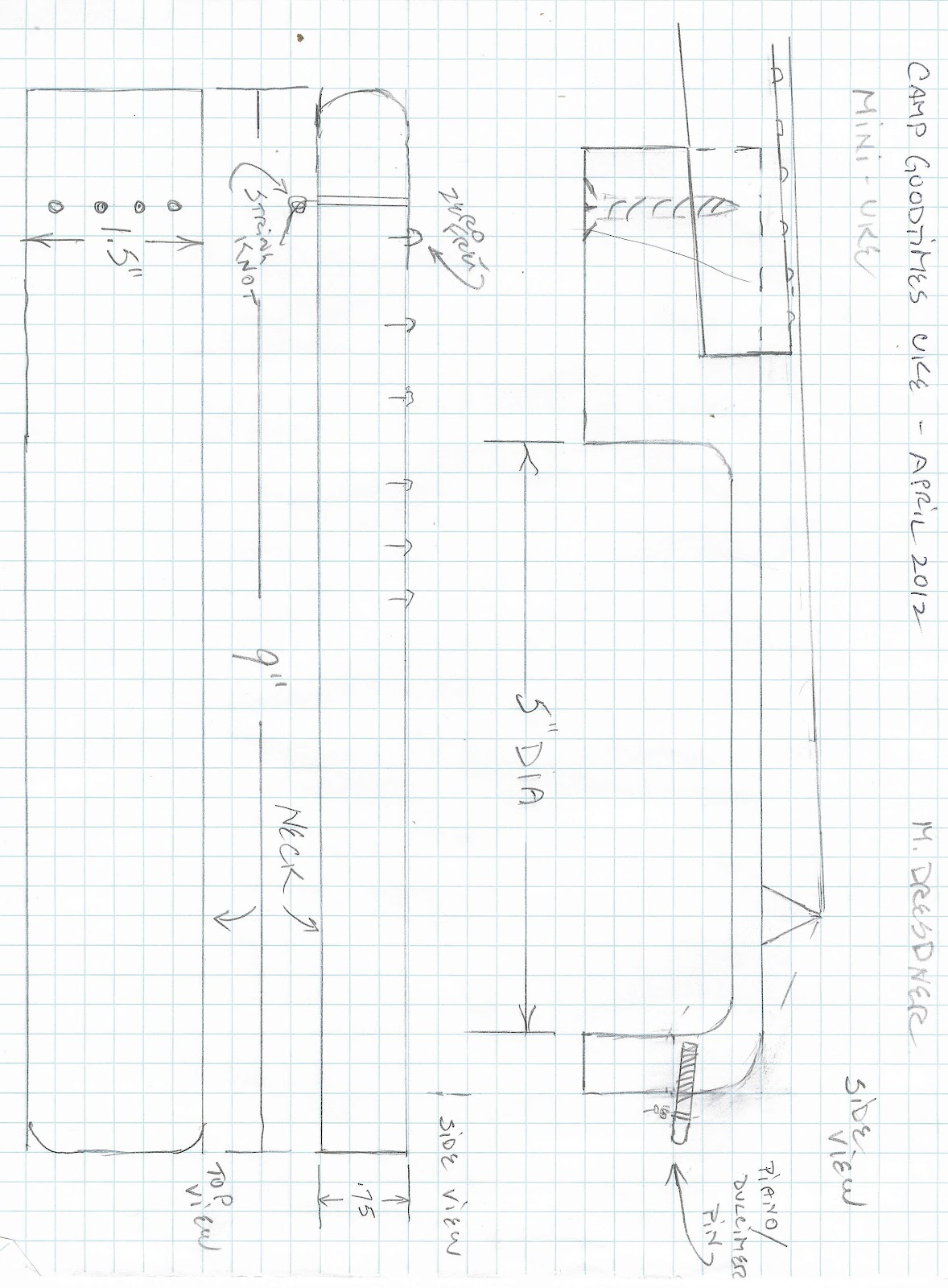

I drew up plans for a pineapple shaped body cut from a 6” by 8” board, with a five inch circular rout from the back leaving barely an eighth inch top remaining. The bridge would be a wood triangle and the neck a stick of wood, slotted and fretted. It would be bolted into a pocket routed in the top, with zither pins at the bottom of the body to tighten the strings. Once knotted, the strings would go through small holes in the neck just past a zero-fret nut. (I’ve included the original drawings, and photos of the parts, in case another charity-minded group wants to do this for another worthy set of recipients.)


I took neck wood and uke strings from my shop and bought hundreds of zither pins and tuning wrenches. Ken Warmoth of Warmoth Guitars immediately offered the body wood, screws, fret wire, and all the programming and CNC running time to slot the necks and cut the bodies. Several local individuals donated money to offset the cost of the parts, but we also needed labor to assemble the kits. A Pierce County employee and three Argosy employees helped out, but the lion’s share came from the local high school.


Jon Cerio, the woodshop teacher at Rogers High School in Puyallup, introduced the idea to his class, and they took to it. His students cut the bodies on their CNC machine, shaped and fretted necks, and did the secondary machining and sanding. They then used their program’s laser to engrave each uke with “Camp Goodtimes.”  


And that’s how a few people in Puyallup and a bunch of enthusiastic high school kids gave up their time to a project to cheer up youngsters stricken with childhood cancer. By the time camp is over, 100 kids will head home with a ukulele they put together themselves, with a little help from a very caring community.

#30

YouTube story by KIRO TV news about Camp Goodtimes


For more information, contact:
Michael Dresdner   253 770 1664
www.rainydayukes.com


Saturday, June 16, 2012

A Funny Thing Happened on the Way to the Forum


A tumultuous three-ring Forum
by Michael Dresdner


A Funny Thing Happened on the Way to the Forum at Lakewood Playhouse, deftly directed by Brie Yost, is a rollicking, bawdy, musical comedy that can barely contain itself. Think Marx Brothers meets Three Stooges and you’ll have a sense of what transpires. An outstanding cast creates a three-ring-circus of singing, dancing, and lowbrow comedy peppered with puns, sight gags, and humorous anachronisms, all played out in outstanding costumes on a beautifully conceived and elaborately painted stage.

Set in 200 BCE Rome, the basic plot has young Hero (Colin Briskey) in love with a face in the window of the brothel across the courtyard. The face belongs to Philia (Gretchen Boyt), a vapid blond virgin whose only skills are seduction and obedience, and who is already sold to a soon-to-arrive soldier, a vain braggart of a captain.

When his parents leave him in the care of their aptly named slave Hysterium (Alex Smith), Hero upends things by promising freedom to his other slave, the devious Pseudolus (Christopher S. Cantrell) if he gets Philia away from brothel owner Marcus Lycus (Jeffrey Weaver). That plot device allows Cantrell to initiate a madcap parade of mayhem.

Cantrell’s Pseudolus orchestrates the show like a Roman era Jackie Gleason, a manipulative puppeteer racing from one exhaustingly convoluted song and dance filled scheme to the next. Through it all he is abetted and amplified by a delightfully funny trio of Proteans (Josh Johnson, Coleman Hagerman, Jed Slaughter) who appear regularly in various characters and costumes, singing, dancing, mugging, doing acrobatics, and generally adding another layer of distracting hilarity to the already frenetic action.

For our viewing pleasure, Pseudolus gets brothel owner Lycus to parade across the stage a bevy of varied and appropriately costumed dancing courtesans. Mute but physical, they gyrate lasciviously enough to arouse not only the rapt men, but even the fountain in the courtyard. Cantrell’s Pseudolus also manipulates the hapless, excitable, marionette-limber Smith into cross dressing, lying, and even faking death, and cons everyone in sight in every way possible.

Subtle but humorous anachronisms abound. Soldiers drink water from a plastic bottle and the captain wears a sundial wristwatch. A wizened, addled neighbor named Erronius (Martin J. Mackenzie) reappears regularly as he circles the city on foot, wheezing and humming classic theme songs from shows like Bonanza and The Adams Family.

Supporting the excellent cast is a worthy support crew. The simple, very functional set, designed by Blake York and deftly painted by a crew led by Jen Ankrum, is beautiful. Costumes are outstanding, from the variety of Roman upper class and slave outfits, through some amazing togs on the dancing courtesans, down to both humorous Protean and elegant soldier’s outfits. Lighting by Kristen Zetterstrom is suitable unobtrusive, and music is provided by a very capable quartet led by Terry O’Hara. 

I should mention that while this is a musical, its strength is more in its comedy than its songs. Don’t expect great soloists, deep emotion or cerebral repartee. This is vaudevillian slapstick at its finest, and at that, it is fine indeed.

A Funny Thing Happened on the Way to the Forum
June 15th to July 8th
Lakewood Playhouse


Sunday, April 29, 2012

The Musical Comedy Murders of 1940


Chock Full O’ Nuts
by Michael Dresdner


The Musical Comedy Murders of 1940 is a lush, beautiful tableau of dazzling costumes, an intricate set, and a spate of characters from the gritty yet glamorous pre-war era. As it opens, a maid is stabbed to death.

Gory, right? Nope. Hilarious. The victim, played by a master of physical comedy, creates a chuckle-invoking death routine, then keeps the laughs going as the murderer props and drags her contorting body hither and yon before taking it offstage.

You see, in spite of it’s name, this is far less a murder mystery than a complete comic romp; think “The Pink Panther” meets the Marx Brothers.  

Act one sets up the basic storyline. The personnel of a play, including actors, director, producer and composer, gather at the home of a potential backer, ostensibly to do a presentation of a musical. They soon realize that many of them are from a previous play closed due to a mysterious killer who knocked off fellow theatrical denizens, and that he or she is probably in their midst today. Sounds spooky, right?

Well, it’s not. In fact, now that you know the story line, you can forget it, because by the time act two gears up, we find that most of the characters are not who they say they are. What was set up as a straightforward murder mystery is quickly replaced with fast paced lunacy.

There are frenetically mimed instructions to control a befuddled woman trying to explain inconsistencies, a half naked struggle for a gun easily misread as an energetic bout of copulation on a desk, and a rash of comings and goings in a maze of tunnels accessed through a group of cleverly hidden secret doors. And through it all, there’s a steady stream of great set ups and comic one liners.  

But most of all there are characters who are…, well, complete characters.

We have the maid (Melissa Thayer), who in spite of having seemingly been killed, sticks around through the whole play, continuing to display the superb comic talent she opened with. The owner of the home and potential backer (Liz Tomski) introduces a cop (Mark Peterson) as her servant to the theatrical group of visitors. Said visitors drift in through a snowstorm and include an Irish (?) tenor (Blake York), a foppish, tonsorial director (Joseph Grant), an ingenuous chorus girl (Jen Akrum), a stand up comic (Matt Garry), a stuffy producer (Virginia Yanoff), a flamboyantly gay musical director (Jeffrey Weaver), and a histrionic lush of a lyricist (Jen Aylsworth).

You’ll notice that I didn’t bother with their character names, because too many change both names and personas before this is over. There’s also no sense calling out singularly superb performances, because this is a true ensemble piece, and they were all truly outstanding, both separately and together. In fact, part of what makes this work is perfect timing and delivery in both actions and lines, a tribute both to the actors and director James Venturini.

The support is no less. John Munn designed a beautiful and fiendishly clever set that expertly hides a wealth of hidden doors. Costumer Diane Runkle pulled out all the stops, dressing the cast in gorgeous and spot on period clothes. Even the wonderful props, by Karrie Nevin, get into the comic act.

By now you should be largely confused, convinced you know precious little about this play, right? Fair enough; I’ll clarify by telling you there are only two things you really need to know.

First, The Musical Comedy Murders of 1940 at Lakewood Playhouse is a convoluted, high energy farce that will leave you laughing and delighted by the time the final curtain falls. Second, you should definitely go to see it. But get your tickets soon. This one will surely fill the seats once word gets out.


The Musical Comedy Murders of 1940
April 27 to May 20,2012
Lakewood Playhouse