Sunday, January 12, 2014

Who's Afraid of Virginia Woolf at Lakewood

True Gritty
by Michael Dresdner

L to R: Niclas R. Olson, Kirsten Deane, Steve Tarry                            All photos by Kate Paterno-Lick

This month, Lakewood Playhouse has chosen to put on Edward Albee’s Who’s Afraid of Virginia Woolf, a play that is widely acclaimed, yet not easy to watch. It takes the audience deep into the midst of a dysfunctional marriage mired in not physical, but rather emotional sado-masochism.

This is hardly the first work in which an artist, in this case a playwright, intentionally pushes the audience well outside their comfort zone in an attempt to show a particular slice of life, engender a gut response, or simply shake up viewers. Thus, while it is a finely crafted play that is well executed by this director, cast, and crew, it is nevertheless, not for everyone.

Perhaps I should stop and quickly explain my goals in reviewing a play so you understand how this can be helpful to you.

First, I try to give you enough information about the play itself to decide if it is the sort of thing you would want to spend time experiencing. Second, I give you an idea of how well or poorly it was executed.

Not surprisingly, there are some plays that get rave reviews for their craft but are not going to be your cup of tea, and frankly, this may be one of them. Let’s dive in so you can decide.

George (Steve Tarry), a rather plodding college professor, and his wife, Martha (Brynne Garman), the daughter of the college’s president, are in a long marriage that has devolved into an almost constant game (his oft-repeated term) of alcohol-fueled verbal and emotional assault on one another.  They have very different styles of attack; he is witty, droll, passive-aggressive, and erudite, while she is a somewhat traditional manipulative harpy who alternately purrs, snarls, swears, and screeches.

L to R: Brynne Garman, Kirsten Deane 
Nor do they take a break from their hostilities when they invite a new young professor, Nick (Niclas R. Olson) and his sweet, naïve wife Honey (Kirsten Deane) over for drinks. As the night wears on, the older couple turns from their mutual destruction to attacking their guests, after first drawing them in to discover sufficient information to be able to truly hurt them. As Nick gets drunker, he responds combatively in kind, while his wife repeatedly retreats to the bathroom to vomit out both the pain and the alcohol.

In time we get the sense that some of this vituperation is for show, some for the sport of the game, and perhaps some to elicit a response from their guests. Still the “game” is played with verbal barbs that are not blunted for safety, and everyone gets wounded. However, at the very end of the play it becomes clear that, at least for George and Martha, this really is a game; a dangerous one, perhaps, but one they can put away at the end of the night and envelop back into their marriage of need, if not love, for one another.

Larry Albert’s directing was excellent, as was the very challenging work by the small, four-person cast. Tarry, who as George gets the cleverest lines of well-crafted word play, did a wonderful job of bringing an overlay of calm and an almost Will Rogers style wisdom to the maelstrom. With a mature aplomb, he’d slide his barbs in like a shiv, leaving the more direct battering to Garman’s Martha.  Olson and Deane did a fine transformation from fresh-faced and sober to decaying drunks, a change that was particularly well nuanced by Deane’s innocent Honey.

A simple, appropriate set (James Venturini), lighting (Amanda Swegen), set dressing (Hally Phillips), and sound (John Burton) all helped create the scene. Diane Runkel’s costumes established the time period nicely, with Nick’s iconic tie almost single-handedly telling us the year. In short, it was an excellent production, if you like that sort of thing.

And there’s the rub. If theatre for you is something to make you cheerful at the end of the night, this play won’t do it. However, if biting drama that will take you through realistically gut wrenching emotional upheaval is a ride you favor, come see Who’s Afraid of Virginia Woolf at Lakewood Playhouse.

Who’s Afraid of Virginia Woolf
Jan. 10 to Feb. 2, 2014
Lakewood Playhouse

http://www.lakewoodplayhouse.org/

Tuesday, December 3, 2013

It's a Wonderful Life at TLT

A Curate’s Egg

by Michael Dresdner

L to R: Lydia Hedman, Dan Lysne, Kirsten Deane   All photos by DK Photography


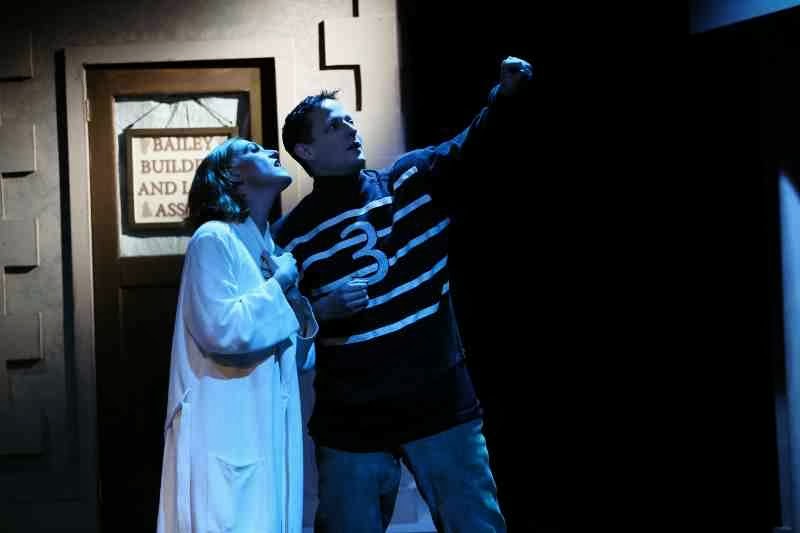
In the stage adaptation of the obligatory seasonal indulgence It’s a Wonderful Life, George Bailey’s business, the Building and Loan, is a somewhat ramshackle place with a noble mission and a heart of gold. The same can be said for Tacoma Little Theatre’s production, directed by Maria Valenzuela. It’s a bit rough around the edges, but has enough heart to win over its audiences.

L to R: Jordan Talbot,
Jameil Jackson, Dan Lysne 
You probably know this, but bear with me for a short synopsis. George Bailey (Dan Lysne) runs the modest building and loan company started by his parents (Curtis Beech and Leigh Duncan) after being repeatedly foiled in his desire to flee the small town of Bedford Falls and see the world. When his partner and uncle Billy (George Mc Clure) loses enough money to shut down the business on the eve of a bank examiner’s visit, George decides to end it by jumping off a bridge. He’s stopped by a guardian angel, Clarence Oddbody (Gary Spees) sent by the Angel Superintendent (Andrew Fry) who acts as the de facto narrator of Bailey’s background story. Clarence shows George what the town and its inhabitants would be like if he’d never been born, and he realizes he is indeed a valued cog in the gears. Convinced, he returns to his wife and children to find that the whole town has turned out to cover the monetary loss and reassure George of how much he is loved and appreciated.  

Tom Birkeland, in wheelchair, with ensemble 
I must admit that I was particularly eager to see Tom Birkeland, who plays the wheelchair-bound Mr. Potter, George’s nemesis and the wealthiest, crankiest man in town. Birkeland has long been one of the South Sound’s most outstanding actors, but has been on medical hiatus for a number of years. He’s lost nothing; his performance was balanced, powerful, and flawless, and easily the shining light of the play. It’s nice to see the old timers showing the young how it’s done.

L to R: Kirsten Deane, Dan Lysne
A close second was Kirsten Deane, who played George’s wife Mary with just the right mix of warmth, coyness, affection, and ebullience. It’s a huge cast, too big to list, but there were other high spots as well, like the short but well-played role of the young George by Brian Loughridge, and the before-and-after maturation of Violet Bick, played by Allyson Jacobs-Lake.

With 27 separate scenes in a dozen different settings, the task of coming up with a set that worked for all must have been daunting. With a bit of imagination and a parade of moving furniture pieces, Blake York’s complex set held up quite nicely to the play’s considerable demands. The same can be said of Michele Grave’s costumes, Pavlina Morris’ lighting, Karrie Nevin’s props, and the sound design by Darren Hembd, which included a live piano accompanist, Zachary Kellog.

This is not slick, polished, professional theatre, but one could argue that it’s better this way. It’s a Wonderful Life is all about heart, love, and the regular folk of a town, and that’s just the feeling this production conveys. If you, like so many, need a yearly dose of this heartwarming Christmas classic, this play is a far better way to consume it than sitting in front of the TV for yet another rerun of the movie you know by heart.  

It’s a Wonderful Life
Nov. 29th to Dec. 22nd, 2013
Tacoma Little Theatre


Aladdin at Centerstage

The Dog’s Bollocks

by Michael Dresdner

Left to right: Terry Edward Moore, Kate Alden, Casey Raiha

Centerstage has now established a tradition of presenting English Panto each Christmas season, and they do it divinely. This year’s delightful entry is Aladdin, directed by Roger Curtis, and trust me, it’s the dog’s bollocks.

(For you Yanks out there, “the dog’s bollocks” is a British slang term meaning awesome.)

Pantomimes, or Pantos, are raucous, riotous, randy interpretations of fairy tales aimed squarely at families with children, larded with layers of humor sure to hit all ages, song, dance, and lots of audience participation. The players talk with the audience, encouraging them to help out, cheer the heroes, who enter stage right, and boo the villains, who enter stage left.

(Another note for you Yanks: In this case, Pantomime does not mean silent. After an 18th century audience clearly preferred the spoken preamble, a mime show’s savvy producers threw out the silent portion of their two part entertainment. Somehow, the name pantomime stuck, along with a host of traditional conceits.)

This year’s offering boasts incredible sets (Steffon Moody), stunning costumes (Deb Skorstad, Malia Seavy) and wigs (Jonni Whitby, Barbara Peterson), reams of often hilarious props (Becca Hines, Mary Sawyer, Laura Campbell), clever lighting (Amy Silvera), lots of songs, and superbly executed dance numbers (dance captain Katherine Jett) performed by the entire light-footed cast. As always, the heavy music load is adroitly handled by house musical director and resident genius David Duvall and his backup band (Andrew Carson, Mike Eytcheson, Kaarin Lysen, Matt Goodin)

In addition to the attractive and talented romantic leads, Aladdin and Jasmine (Casey Raiha and Kate Alden), Pantos typically have certain obligatory characters, often intentionally played by the opposite sex. For instance, there’s a “male” cop, PC Pongo, played by a young, sexy woman (the stunning Anna Marie Clausen) who is costumed so you don’t ever forget it. Abanazar is this iteration’s personification of evil (Terry Edward Moore ), the Emperor of Cathay (Dale Bowers) is the blustering, foolish father, and the necessary fairy godmother this year is a pair of male and female genies (Josh Williamson and Brynne Geiszler), she in traditional belly dancer garb and he decked out like an over-the-top disco dude. But my favorite repeat character is the ugly old hag of a woman played by a rather large male. Artistic director Alan Bryce took the droll but juicy part of Widow Twankey and made it hilarious. He was but one of many cast members who got to reel out one-liners filled with subtle innuendo, bad puns, topical gibes, and locally-aimed insults.   

One of my favorite bits, and one the audience is encouraged to help with, is a mockery of the song Twelve Days of Christmas where “a partridge in a pear tree” is replaced by “a bra that is made to hold three.” Don’t even ask what the rest of the days are, but be assured there will be enough custard pies hurled to satisfy even the most jaded theatre goer.

If you’re already a fan of Panto, this one is not to be missed. For those who’ve never experienced it, be certain to make time in your schedule to go to Aladdin at Centerstage, and expect what’s possibly the most delightful two hours you’ll spend this holiday season.

Aladdin  
Nov.30 to Dec. 22, 2013
Centerstage

Wednesday, November 13, 2013

Driving Miss Daisy at Dukesbay

Southern Comfort

by Michael Dresdner

   L to R: Syra Beth Puett, Malcolm J. West                                         photo by Jason Ganwich

If you are only doing one show in a season it had better be perfect. As luck would have it, this one is.

Driving Miss Daisy is the one and only play of the season for the fledgling Dukesbay Productions in its new quarters in the Merlino building, which also houses the Grand Cinema. Three ideally cast, outstanding actors make this play, directed by Julie Halpin, as good as it gets.

The setting is Atlanta in 1948, a time and place of societal rules and racial divides that dictate every step of the complex dance of social and business life. Daisy Werthern has just wrecked a brand new car, but still objects vehemently when her devoted son, Boolie, insists she stop driving. Daisy is a feisty, opinionated, proud, elegant 72-year-old Southern Jewish widow who wants no help, or interference, from anyone.

Over her objections, Boolie hires a mature black chauffeur named Hoke Coleburn to drive his mother. Hoke is the perfect foil for Daisy; proud, clever, picaresque, gentle, patient, and skilled in the ways servants gently guide their employers. Daisy distrusts him and resents his presence in her house, her car, and her life, but in the face of his deferential charm and almost endless patience, she slowly comes to accept him.

Through a series of short scenes covering the next 25 years, we watch the gradual transition from employee held at arm’s length, to what eventually becomes a deep and trusting friendship. The various scenes are often quite funny, always compelling, and ultimately, deeply moving.

Syra Beth Puett (who is from Alabama and thus comes by her accent honestly) plays Daisy as if the role were written just for her. She has the look, demeanor, attitude, rhythm, and voice down pat, and ages convincingly through the years. She’s so perfect that it’s hard to imagine anyone else playing this role at all, much less doing it as well.

The same can be said for Malcolm West as Hoke. He’s got a delightful range of facial expressions paired with the right voice, accent, and demeanor to convince us he’s the real deal; that rara avis of menials whose confident self-respect, innate goodness, and genuine compassion can turn a cantankerous, suspicious, white Southern lady into a true friend.

Rounding out the cast is Robert Geller as Daisy’s adult son Boolie, and though his role is smaller, he turns in the same outstanding performance. He’s completely convincing as the gentle but firm, loving but sensible son who juggles a successful business, his own family, and the frequent demands of his mother.

Dukesbay’s space is perfect for this intimate show. A very wide, but not too deep stage faces just two rows of seats, the second of which is on a riser. Thus, everyone is close enough to hear every whisper and ideally positioned to see each facial expression.

A clever, tri-partite set, which uses lighting for set changes, lets the action take place at Daisy’s home, Boolie’s office, or the car in which Daisy and Hoke spend much of the play. David Wehmhoefer is responsible for both the set and lighting. The right period music (Nic Olson) and well-chosen costumes add their deft touch as well.

If this level of quality is any example of what we can expect from Dukesbay, then we are in for a real treat, and they are a most welcome addition to the South Sound theatre scene.

This is a sort run, so I’m going to urge you in the strongest possible tones to go see it. Yes, it’s that good.

Driving Miss Daisy
November 8 – 23, 2013
Dukesbay Productions
http://dukesbay.org/

While you are at it, you might also want to check out Alec Clayton's take on this play at:
http://alecclayton.blogspot.com/2013/11/dukesbay-productions-driving-miss-daisy.html


Sunday, November 10, 2013

The Weir at TLT

A man walks into a bar…

by Michael Dresdner

from left: Robert McConkey, Brian Wayne Jansen, David Wright, Ellen Peters and Gabriel McClelland
photo by DK Photography

The best thing about The Weir at Tacoma Little Theatre is that there doesn't appear to be any acting in it. The cast is so good and so comfortable in their roles that instead of being aware of actors on stage, you get the feeling you've wandered, like a fly on the wall, into an Irish pub peopled with a batch of regulars. They sound and behave like familiar Irish barflies, even when their regular laconic routine is altered by one new visitor.

The barman, Brendan, adroitly and seemingly effortlessly played by Robert McConkey, hosts two of his obvious regulars. Jack (David Wright) is an older, salty character who fancies himself much more of a curmudgeon than he actually is. Jim (Brian Wayne Jansen) is a meek man, a blue collar, freelance worker cowed by life itself. They drink and engage in their normal, friendly chatter until Finbar (Gabriel McClelland), a local businessman, brings in an attractive young woman to whom he’s just rented one of his properties.

The presence of Valerie (Ellen Peters) adds a bit of sexual tension, both with the married Finbar and the three single men. She becomes the catalyst for their normal banter to give way to stories, each with some sort of supernatural twist, and each more recent in time than the last. They’re subtle, and could all possibly be explained with logic, though no one goes there. 

Ellen then tells her story, one of deeply personal, very recent pain, and touched only lightly with an eerie tag. It draws real compassion from all the men, and a palpable personal connection for the whole group.

After Finbar and Jim leave, Jack opens up with his own deeply personal story of lost love and missed opportunity, exposing his feelings far more than he normally does in his favorite watering hole. You are left with the sense that they've all opened up to a degree that prevents them from ever returning to their former superficial relationships with one another, and in turn, have permanently accepted Valerie into their circle.

The play was directed by pug [sic] Bujeaud on an absolutely perfect set by Blake R. York, with props by Katelyn Simpson, set dressing and scenic art by Jen Ankrum, and lighting by Michael Christopher. It’s the quintessential Irish pub, at least as we in the states imagine it to be. Costumes by Michele Graves, lighting by Michael Christopher, and subtle sound by Gabe Hacker all added to the realism of the tableau.

I have to admit I would have liked to have seen this in a more intimate, black box setting, but they managed to pull it off superbly even in this fairly large proscenium theatre.

My one bit of advice is to get tickets early. This is a very short run and the night I was there the theatre was packed.   

The Weir  
Nov. 8 to Nov. 17, 2013
Tacoma Little Theatre
www.tacomalittletheatre.com 

For another opinion, here's Alec Clayton's review of The Weir at his blog: 
http://alecclayton.blogspot.com/2013/11/the-weir-at-tacoma-little-theatre.html


Saturday, November 9, 2013

Pride and Prejudice at Lakewood

Austen translation 

by Kaitlin & Michael Dresdner

Foreground: Jacob Tice (left) as Mr. Darcy, Tony Onorati (right) as Mr. Bingley      photo by Kate Paterno-Lick


It is a truth universally acknowledged that a novel adapted for the stage will, of necessity, be different than the original. Compacting a literary masterpiece like Pride and Prejudice into a two-and-a-half hour production requires adjustments, which is to be expected. If you are a fan of the 2005 movie version of this literary classic (the one with Keira Knightly,) but thought it needed more comic relief, you’ll probably love the Lakewood Playhouse treatment of Pride and Prejudice. However, if you are a die-hard fan of the original Jane Austen classic, you may be less than amused.

The play revolves around the Bennets, who have five daughters and no sons. Thanks to primogeniture, a distasteful male cousin will inherit their home once their father dies. That encourages their well-intentioned but vulgar mother to drill into her daughters, and anyone else within earshot, the importance of marrying into money and position.

The eldest, Jane, who is beautiful, modest, and so reserved of emotion and speech as to be often misunderstood, falls for wealthy Mr. Bingley, though that pairing is beset by obstacles from his family and the ever-present class imperative of never marrying below one’s station. (To quote a very different movie, where a chauffeur’s daughter falls for the wealthy family scion, “No one poor was ever called democratic for marrying someone rich.”)

The second, equally beautiful daughter, and the true protagonist of the play, is the intelligent, strong-willed Elizabeth. She is at first offended and repelled by ultra-wealthy, aloof, prideful Mr. Darcy, but gradually comes to see him in a very different light as the truth about him slowly trickles in.

The remaining characters fill out the broad palette of this societal tableau. The other daughters range from severely bookish and reticent Mary to unabashedly coquettish and ebullient Lydia. Relatives and acquaintances run the gamut from the imperious Lady Catherine de Bourgh and the duplicitous Mr. Wickham to the thoroughly genial Gardiners. It’s a long play (easily two and a half hours,) with an abundance of mimed piano playing and real dancing, but it does eventually wind its way to a generally happy conclusion.

Rules of etiquette of the day made it almost impossible for people to speak frankly with one another, so there’s plenty of room for misunderstanding, privately nursed disappointments, and misguided reactions. That’s a large part of what creates the tension and frustration that drives both this genre and this story.

This version by Hanreddy and Sullivan, and directed by Casi Wilkerson, is substantially different than the original book. At times it seemed as if the story got the Disney treatment, where sour characters, like Mr. Bennet, are made more pleasant and likable, and distasteful archetypes, like Mrs. Bennet and Mr. Collins, become brassy, comic stereotypes. The vulgarization also extends to the language, which bounces back and forth between classical Victorian English, directly from the novel, and more modern phrases, often mid-sentence.

Steve Tarry’s well-executed Mr. Bennet was indeed more likable than his book persona. Both Shelleigh-Mairi Ferguson as Mrs. Bennet and Paul Richter as Mr. Collins kept the audience laughing out loud with their antic portrayals, and Annie Coleman’s Caroline Bingley almost out-sneered Cruella DeVille. Mind you, these are adaptation and direction choices, and like them or not, they don’t imply poor acting. Still, I doubt Jane Austen would recognize them as her own creations.

Other cast members stayed, in varying degrees, closer to the originals. The leads, Jacob Tice (Mr. Darcy) and Rachael Boyer (Elizabeth Bennet) were both excellent, though their direction had them revealing rather more overt emotion than early 19th century societal mores would have allowed. Some actors, including Tony Onorati as Mr. Bingley, Elena Easley as Jane Bennet, and Christa Knikerbocker as “plain” sister Mary Bennet, managed, in spite of what was going on around them, to turn in excellent portrayals that were also entirely true to their origins. They were a welcome anchor to the original literature and stood out by not standing out. The remainder of the fairly large cast was mostly appropriate and more than decent, providing a reasonable and stable platform for the leads. 

There was no set to speak of, and the sum total of furniture and props consisted almost entirely of a table, a tray, and a mismatched set of chairs. (One wag at intermission insisted there was no scenery because it had all been chewed.) Everything, from the oft-played piano to teacups and letters, was mimed. Even clothing got into the act. In one notable scene, Elizabeth reads a from an imaginary piece of paper and then mimes slipping it into a non-existent pocket on her costume. 

The many major locations and settings in the story were also left to our imagination, abetted by lighting changes (Niclas R. Olsen), rearranged furniture, and the dialog itself. While the minimalism of the scenic design worked well for the space, it may leave those unfamiliar with the story a little puzzled about where they find the characters in a given scene.

Costumes (Frances Rankos), a challenge to be sure, were mostly impressive with occasional gusts of anachronism. If you keep your eyes centered and avoid looking too closely at the hats and shoes, you’ll be fine. Music, consisting largely of necessary piano playing, fitted nicely and was well chosen.   

I’m sure that for many, this is a delightful indulgence; a chance to wallow in the genteel world of the Regency era without wading through the occasionally tedious novel. Pride and Prejudice is perhaps the standard bearer of what Oscar Wilde sneeringly called “the three volume novel,” and like all classics, is something everyone should experience, perhaps more than once. With its upbeat pacing and overt humor, this may be just the version you’d most like indulging in.

Pride and Prejudice
Nov. 8th through Dec. 1st 2013
Lakewood Playhouse

Saturday, October 19, 2013

Steel Magnolias at TLT

A perfect storm
by Michael Dresdner

L - R: Carol Richmond, Dana Galagan, Jessica Robins, Gretchen Boyt, Stephanie Leeper, Kathi Aleman.  DK hotography 


Steel Magnolias is an amazing property, beautifully written with endless wit, darting one-liners, richly crafted characters, and ultimately, deep, wrenching emotion. Tacoma Little Theatre graced it with an outstanding ensemble cast and a sterling director who added sparkle, humanity, and flawless timing to create a perfect storm of a theatre experience. This is truly a must-see play.

Great plays start with great choices, and director Elliot Weiner has made them well, choosing what felt like the perfect actor for each of the character-rich roles. He added excellent pacing -- fluid, snappy, and captivating -- and combined it with some very clever staging. A large imaginary mirror at the front of the stage allows the actors to look at one another in its reflection while always facing directly toward the audience. The conceit helps draw us intimately into Truvy’s carport-turned-hair salon so well that in spite of the proscenium stage, we feel like we’re right there among the scissors and combs.

Truvy’s hair salon is the ad hoc meeting place for six diverse but intertwined women from a small Louisiana town. Set against the backdrop of their own changing lives, the friends gossip, snipe at one another, complain, and reminisce about past and present husbands and lovers, and the vicissitudes of life. The lines are fast and very funny, and we’re soon roped in by each personality in this charming group.  

Things get tense when M’Lynn’s daughter, Shelby, who is about to be married, decides to have a child against the advice of her doctor,  who warns pregnancy could tip her diabetic state into mortal danger. M’Lynn is forced to walk that fine line between aching to force her daughter into common sense and fear of alienating her. Ultimately, Shelby’s choice leads to the inevitable, triggering a shattering emotional release from M’Lynn, cushioned only by the loving support of this circle of genuine, devoted friends.

The plays trappings -- set, lights, sound, costumes, props -- were all top notch, but this play is really about the acting. Fortunately, the six women in the cast were absolutely superb, right down to their comfortable Southern accents.  

Stephanie Leeper artfully crafts Truvy, the big-haired, flashy, doyenne of style, into a calming, caring den mother to her shy, confused employee and her circle of customer/friends. Jessica Robins plays her timid, unmoored employee Annelle, who eventually recreates herself through religion. Dana Galagan is bitingly funny as Clairee, an older, richer, wiser voice in the fray, whose mutual sniping with her equivalent counterpart, Ouiser (pronounced “Weezer”), adroitly brought to life by Carol Richmond, hides their thinly veiled affection for one another.

Then there’s Gretchen Boyt, the beautiful, sweet Shelby, a southern belle so charming that no one can help but love her. Capping it all is Kathi Aleman as M’Lynn, Shelby’s emotionally torn mother who struggles to quell her very obvious frustration at not being able to talk sense into her free-spirited daughter.

It is Aleman who brings the most powerful performance to the table, erupting into a passionate release of anger, pain, frustration, and tears at her daughter’s demise at the climax of the play. By the time she was done, the entire audience was riveted in stunned, tearful, breath-bated emotion. Atop a play filled with great acting, hers was a performance not to be missed.

Backing up all this stellar cast was a delightfully appropriate set by Blake York and scenic artist Brie Yost, along with wonderful costumes (Michele Graves,) lighting (Matt Lawrence,) and props (Katelyn Simpson.) Jeffery Weaver did a great job on hair and wigs, critical to a play set in a hair salon, and Lynn Harper Nelson was the dialect coach who helped with their vocal realism. Sound design, by Nena Curley and director Elliot Weiner, added yet another dimension to the play. In fact, the radio on the set almost becomes another character, waking up to spew exactly the right song for the moment and mood each time one of the women bops it with a fist.

It is rare when all of a production’s elements merge so deftly to create a such a notably outstanding play, and you really should see it when it happens. Steel Magnolias is only at Tacoma Little Theatre for three weeks. Make sure you don’t miss it.

Steel Magnolias
Oct. 18 to Nov. 3, 2013
Tacoma Little Theatre