Saturday, May 4, 2013

Little Shop of Horrors at TLT


Little slice of heaven
by Michael Dresdner

photos by Galen Wicks
L to R, back: Deshanna Brown, Alexandria Henderson, Kenya Adams. Front: Benjamin Cournoyer.

Laurels are definitely in order for Tacoma Little Theatre's current offering of Little Shop of Horrors, a high camp, over-the-top musical comedy that hides its dark side with exaggerated stereotypes, impossible situations, and flat out gaudy silliness. It’s a wonderful, lively romp with a sterling cast, an inventive set (Micheal O’Hara), great direction (Maria Valenzuela), superb musical backing (Terry O’Hara), and of course, the delightful puppets comprising Audrey II, in all their growing iterations.

Little Shop started out life in 1960 as a B movie reputedly based on a 1932 short story about a man-eating (person eating?) plant.  It was shot for only $30K and laced with enough Jewish humor that some saw it as anti-Semitic. Much of the Jewish humor remains. For instance, owner Mushnik’s top customer is the Shiva Funeral home, a not at all subtle reference to sitting shiva, the traditional Jewish seven day mourning practice.  

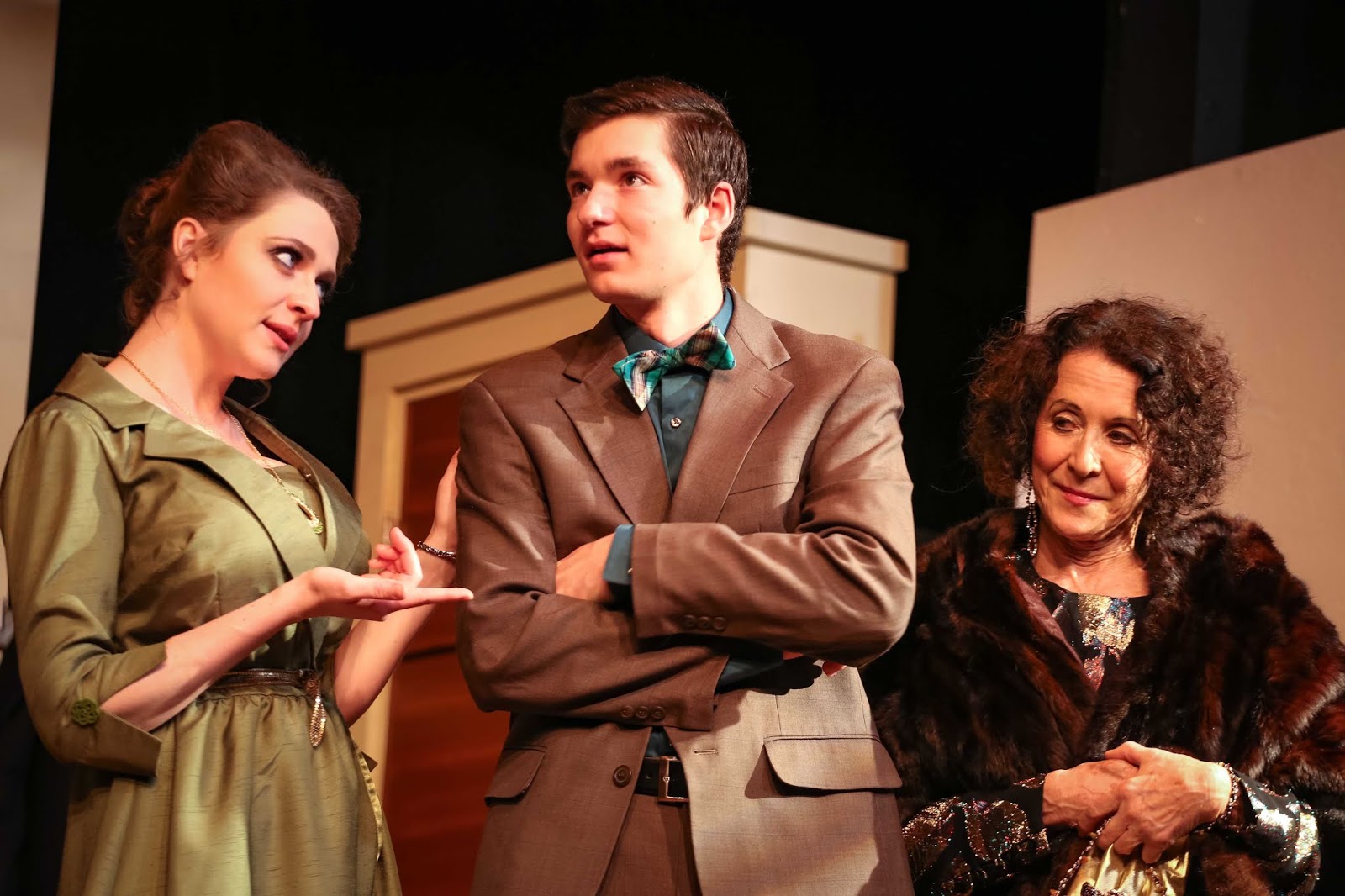
L to R: Andrew Fry, Benjamin Cournoyer, Gretchen Boyt 
Seymour (Benjamin Cournoyer), who is the spitting image of Toad from American Graffiti, works for Mr. Mushnik (Andrew Fry) in his skid row NY flower shop. Just after an eclipse, Seymour finds and buys an odd plant that seems to thrive only on human blood. He names it Audrey II after his beautiful but ditzy co-worker, Audrey (Gretchen Boyt), the secret love of his life who is in an abusive relationship with a sadistic dentist (Justin Michael Thornton) . As Audrey II grows ever larger, the plant brings fame and fortune to the shop, eventually sorting out all the personal issues afoot, though not necessarily in a good way.

Cournoyer is wonderfully nerdy as Seymour, though admittedly, his singing does not quite come up to his acting chops. The same is true of Fry’s gruff, decidedly Jewish Mushnik. Boyt is delightfully slinky as the lower east side denizen Audrey, replete with great singing voice and convincing accent. Thornton , as her dentist boyfriend, sings, dances, and struts magnificently, doing yeoman service not only in that role, but in three other smaller ones as well. Unseen but just as vital is James Wrede working the series of oversized Audrey II puppets, all voiced by Carmen Brantley-Payne. Both work mostly behind the scenes but also have bit parts on stage.  

Shining through this overall excellent cast is an amazing doo wop trio. With names reminiscent of the “girl groups” of the 60’s, they act as a Greek chorus to fill in background and story lines with sixties era style song and dance. Crystal (Alexandria Henderson ), Ronnette (Kenya Adams), and Chiffon (Deshana Brown) are a most endearing triple threat in both senses of the term, separately and together delighting the audience with their considerable singing, dancing, and acting skills. In many ways, they are both the glue that ties everything together and the high point of the play.

All the support work is equally noteworthy. O’Hara’s rotating, two-sided sets, convincingly aged with Brie Yost’s noteworthy painting skills, create just the right mood when amplified by Niclas R. Olson’s lighting. Michele Graves’ costumes, as usual, are excellent, especially the doo wop trio, who are also aided by Jimmy Shield’s fine choreography. Unseen but definitely worth kudos was a terrific band, whose names are unfortunately omitted from the program. I don’t know who you are, but my hat’s off to you.

Taken as a whole, it’s fun, it’s boisterous, and it’s silly, but it’s definitely worth your time. Go see Little Shop of  Horrors while it continues its run at Tacoma Little Theatre. It’s a worthy musical finale for this season’s main stage offerings.

Little Shop of Horrors
May 3 to 26, 2013
Tacoma Little Theatre

Saturday, April 20, 2013

The Rainmaker at Lakewood Playhouse


Rainy day people
by Michael Dresdner

L to R: Mason Quinn, Elliot Weiner                           Photo by Dean Lapin 
  
Lakewood Playhouse, apparently set on making us forget about how wet it is this April, has brought the arid, depression-era play The Rainmaker to its stage. This 1954 property is not to be confused with the Grisham lawyer novel/movie of the same name.

A traveling con man named Starbuck (Bruce Story) blows into a drought- crippled town and promises rain in 24 hours in exchange for $100, at the time a serious sum. Insinuating himself into a cattle-raising family, he insists they each engage in a variety of somewhat embarrassing and pointless acts. It’s part distraction and part technique to make them have skin in his game of believing, and intentionally or not, he becomes a catalyst for change.

Sparked either directly or inadvertently by his actions, those he touches overcome their fears. The untrusting learn to hope, the timid become brave, and the self-doubting learn to love, both themselves and those they yearn for but believe are out of reach.

If this sounds like a darker, less melodic version of The Music Man, you’re on the right track. (For what it is worth, The Rainmaker opened on Broadway three years before The Music Man.)

There are some exceptional performances afoot here. Elliot Weiner does a wonderfully subtle job as the father, H. C. Curry, who, after his wife’s death, became a softer, more guiding parent. He accepts and loves his children for exactly who they are, and gently tries to steer each to what he or she needs.

Elder son Noah (Jacob Tice) has taken over running the ranch, and by extension, the family. It’s a burden, but also a bulwark to support his cynical pragmatism, and an excuse to influence his siblings. Younger brother Jim (Mason Quinn), whom Noah sees as rather stupid, is instead a delightfully realistic chap who wins us over with his trusting, energetic hopefulness.

Anchoring it all is a superbly cast sister, Lizzie (Tanya Barber), who believes herself to be too plain to ever land a man, a self-doubt Noah encourages. Her catharsis is at the root of the play.

Rounding out the small cast are the very believable deputy File (Jed Slaughter), emotionally crippled by a divorce he can barely admit to himself, and his constant and stalwart Sheriff (Ernie Heller.) While Story’s Starbuck is not the spellbinder that Preston’s Harold Hill was, he does bring a dose of enthusiastic self-assurance, and does a credible turn in his seduction scene with Lizzie.

All this takes place on an beautifully clever stage designed by Judy Cullen. There are actually three sets; a house, an office, and a barn. All are hidden in plain sight when not being used, thanks in large part to excellent lighting (and dark) effects by Niclas R. Olson.

Diane Runkel does a fine job, as usual, with appropriate costumes, and sound designer John Burton adds another dimension both with accurately subtle sound effects and with superbly chosen musical interludes between the scenes. I can’t say the same about the fight scenes; the fight choreography definitely needs work, and perhaps that will improve during its run.

In the final analysis, I came away feeling that in spite of a lot of great actors and characterizations on that stage, at least as far as opening night was concerned, the whole fell short of the magic that it could be. Perhaps it will improve with age, but even in its nascent state, there’s enough to make it worth seeing.

The Rainmaker
April 19th to May 12th, 2013
Lakewood Playhouse

Thursday, April 18, 2013

It's a Good Day for Miss Peggy Lee


Postscript
by Michael Dresdner

In case you were wondering, the one night show It’s a Good Day for Miss Peggy Lee at Centerstage turned out to be all that I had hoped for, and a good deal more.

As usual, David Duvall both led his stalwart band (Bruce Carpenter, Rich Cole, Paul Baron, Bud Jackson, Bill Branvold, Don Miller, Jon Miller, Don Dieterich) and crafted an absolutely delightful evening that would rival the best of Las Vegas.

But what really put it over the top was headliner Lindsey Larson.

With a cool, sweet, bell-like voice and a superb on-stage demeanor, she charmed the audience and adroitly made Peggy Lee’s music come alive (again.) It was not just a great voice, mind you, but straightforward delivery coupled with a wonderful range of expression. True to the scope of Miss Lee’s long and varied career, she zipped fluidly through a wide pantheon of musical styles, and I can’t imagine anyone doing a better job of it.  

In short, a brilliant impresario led an excellent orchestra behind a vocalist that was perilously easy to adore.  

Hey, I told you not to miss it.

Sunday, April 7, 2013

IT’S A GOOD DAY FOR MISS PEGGY LEE


Putting on the dog
by Michael Dresdner

Lindsey Larson                  Photo: Jason Ganwich
I’ll admit it; my first real awareness of Peggy Lee was as Peg, the sultry lhasa apso in Disney’s classic Lady and the Tramp who sings “He’s a Tramp” to her fellow dog pound inmates. That’s after she voices the film’s two evil Siamese cats, Si and Am, and Lady’s owner, Darling.

No matter; whether animated or live, any way you discover Peggy Lee is a good way.

For those of us who’d like to rediscover, or at least revisit, this amazing icon of songwriting and performing, there’s good news. David Duvall and his Purple Phoenix Productions will be offering a ONE NIGHT ONLY tribute concert of Peggy Lee songs at Centerstage.  

Doing the vocal honors will be Lindsey Larson, a local Seattle singer with a more than respectable performance pedigree. She’ll be backed by the Purple Phoenix Orchestra, replete with Duvall’s own arrangements.

You can look forward to a host of great Peggy Lee tunes, like “Why Don’t You Do Right?” (yes, that’s the one Jessica Rabbit sang in the movie Who Framed Roger Rabbit?), “I Don’t Know Enough About You”, “MaƱana”, “Just For A Thrill”, “Where Or When”, “I’m A W-O-M-A-N”, “It’s A Good Day”, “Big Spender”,
“The Folks Who Live On The Hill”, “Don’t Smoke In Bed” and her trademark hit “Fever”.

Luckily, you don’t need to be a “Big Spender” to enjoy this concert, but you do need to act quickly. Duvall has done a number of similar outstanding one night tributes (Patsy Cline, Lena Horne, Nat “King” Cole, Bobby Darin, Billie Holiday, Aretha Franklin, Rosemary Clooney) and they tend to sell out completely. That’s for good reason; they are amazingly well produced and performed, superbly paced, and generally a sheer delight.

To quote another great Peggy Lee tune, you may well leave the theater humming “Is That All There Is?” and wishing the wonderful experience could go on and on.  

In any case, if you, like me, are a lover of Peggy Lee, don’t miss it.

IT’S A GOOD DAY FOR MISS PEGGY LEE
Saturday April 13, 2013 at 8:00 p.m.  
ONE NIGHT ONLY
Centerstage Theatre  


Sunday, March 17, 2013

The Joy Luck Club at TLT


Red dragon
by Michael Dresdner

It must have felt like going out on a limb for Tacoma Little Theatre to tackle the daunting but superbly written play The Joy Luck Club, based on the deservedly best-selling book by Amy Tan. If so, it was a gamble that paid off handsomely, for the result is astonishingly good and very moving theatre.

The story revolves around four women who formed a mahjong club shortly after emigrating from China to San Francisco, and the complex and often troubled relationships they share with their American born (and Americanized) daughters. Beyond a mere club, the mahjong game reflects both the glue that binds the women and a framework for their life lessons.  

Breaking the fourth wall, both generations of women tell a series of captivating stories directly to the audience. The histories and scenes they describe are cleverly amplified by other actors in small vignettes, or as crisp silhouettes we see moving across a back-lit scrim as they narrate.

Through the mothers’ and daughters’ tales we learn of their often painful pasts, the varied and sometimes convoluted routes that brought the mothers to America, and how their history shaped both who they are and how each generation relates to the other. Thanks to cultural differences in their styles of communication, there is often misunderstanding. The older women expect their daughters to correctly infer their feelings and lessons from what, to the daughters raised around American straightforwardness, often seems a confusing and contradictory set of cryptic signals.

The stories go back three generations and are told in fits rather than with linear continuity. It may seem a bit disjointed at first, but by the end, all the story threads come together to reveal a tightly knit tapestry of history that spans over 80 years, linking two countries and four extended families. Ultimately, the younger generation comes to understand both where they fit as Americans, and how deeply they are still tied to their Chinese roots.

A large and universally excellent ensemble cast plays over 100 different roles in this intricate exercise in compelling storytelling. It would be folly to try and call out each for the myriad of excellent performances they turned in, so I’ll just say they all deserve serious accolades. Admittedly, I was particularly taken with Leilani Berinobis’ Lindo, Ruth Yeo’s Waverly, and all the American boyfriends played by Dan Theyer, but believe me, they were just a few high spots in a very elevated playing field.

Behind the fine acting was brilliant direction by David Hsieh, who crafted a varied and visually compelling tableau from a series of intricate narrations. With spot-on pacing and blocking, he grippingly illuminated the pain, confusion, and joy that the stories revealed.

All this took place across a visually stunning and rather clever multi-level set designed by Burton K. Yuen. It was made up of both horizontally and vertically placed gigantic mahjong tiles that acted as walls, doors, and seating areas bordering the aforementioned scrim, which was trimmed out to look like an Asian-style screen.

With so many stories portrayed by so many actors, there was a seemingly endless parade of superb costumes by Michele Graves, and an equally dizzying array of lighting effects beautifully designed by Niclas R. Olson. In short, it was an outstanding cast led by a terrific director and backed up by an inspired support crew.

Both as a cultural stretch and as first-rate theatre, The Joy Luck Club should not be missed. This is a rara avis even among the many fine theatre offerings in this area. Do yourself a favor and make time to see this outstanding production, which truly is a joy to behold.

The Joy Luck Club
March 15 to April 7, 2013
Tacoma Little Theatre

Sunday, March 10, 2013

Harvey at Spotlight Players


An innocent abroad

by Michael Dresdner


L to R: Ana Bury as nurse Ruth and Rebecca McCarthy as Veta 

Originally debuted in 1944, Harvey is a funny, edifying play that relies on not one, but two dei ex machina that together deliver its simple message. First there’s Dr. Chumley’s almost magical Formula 977 that given once, instantly cures one of both drink and delusion. Next comes a loquacious cab driver who deftly delivers the two-pronged moral of this sweet story; that the devil we know is better than the devil we don’t, and that carefree and pleasant trumps realistic and shrewd.

Kerry Bringman as Elwood P. Dowd
Elwood P. Dowd, very adroitly played by Kerry Bringman, is a wealthy, genial, middle-aged man who spends his time, mostly in bars, talking to folks and making friends while accompanied by an invisible (to others) six-foot magical rabbit named Harvey. Because of Harvey, Dowd’s society-conscious sister Veta (Rebecca McCarthy), abetted by her daughter Myrtle Mae (Amanda Welch) tries to get him committed in a mental hospital. A series of miscommunications has both Veta and Dowd held and released in succession. Confusion ensues, and before long the head of the hospital, Dr. Chumley (Ben Stahl) is chasing both Dowd and Harvey in and out of bars in an attempt to get Dowd locked up, and an annoyed Veta not to sue the hospital.

The confusion is abetted by other intervening characters, all with their own separate issues. Ruth (Ana Bury), the sexy but efficient nurse, secretly loves Dr. Sanderson (Tony Onorati), the second in command at the institution. Both actors did a fine job in their supporting roles. The same is true for Dr. Chumley’s wife Betty (Melissa Isaksen) and Dowd’s Aunt Ethel (Leigh Duncan), who both proved that even a very minor part can be very well executed.

Rounding out the lunacy is an over-eager hospital orderly (Chase Whitener), the household maid (Mandy Stutesman), a judge and lawyer to the Dowd family (Jonathan Mannella), and the aforementioned cab driver (Robert McRill.)

Eventually, the confusion subsides, Elwood gets a chance to expound on his life principles, and he and Harvey manage to win over everyone. They even make love bloom among both the pining and the unlikely.

No set designer or costume designer was called out in the program, but the set smoothly converted back and forth from a hospital reception area to the library of Elwood’s home, albeit one devoid of books. Costumes were certainly adequate, though they failed to convey any particular time period. Also missing from the program were directors’ notes and any announcements of their upcoming shows.

I suppose the sad truth about this production is that it boasts more potential than delivery. That may be partly from co-directors Paul Hill and Katherine Mahoney leaning toward what I’d call an over-the-top style of presentation. However, the grandest obstacle for all involved was the space itself, a cavernous room with poor sight lines and acoustics that can only be called truly abysmal. The result was that nuance was lost and actors’ words were often very hard to understand, either eaten up or rendered cacophonous by the hall.

My bet is that with some refinement and a better space, this group, which has heretofore kept itself completely off the theatre community radar, will have a fair shot at being a critical part of the South Sound’s fine thespian tradition. In the meantime, they need our support in the form of audience attendance, and a lovely play like Harvey is a good venue for us to give it.

Harvey
March 8 to 23, 2013
Spotlight Players Theatre Troupe


Sunday, March 3, 2013

Lend Me a Tenor at Centerstage


WWBHD: What would Benny Hill do?

by Michael Dresdner

Tenor-4643.jpg
Max (Daniel Wood) and Maggie (Kate Alden)

Forget subtlety and dramatic nuance. Lend Me a Tenor at Centerstage is farce in its purest form; fast-paced humor filled with improbable situations, mistaken identity, physical comedy, verbal gags, and very broad portrayals of pure, bawdy nonsense. Its sole purpose is to make you laugh, and this outstanding cast, directed by Vince Brady, is certain to do so.

The plot serves mostly as a vehicle for zany antics, outrageous behavior, and an excuse to rapidly open and slam a myriad of doors. It all takes place in a pleasant, realistic set designed by Michael Ward that consists of the two rooms of a hotel suite. Along with the other amenities, one has a bed and the other a large couch, and yes, both will be used, simultaneously, for just what you expect.

It’s mostly irrelevant and quite convoluted, but here’s a quick synopsis. Famed operatic tenor Tito (Chris Maxfield) arrives in Cleveland for a guest performance of Othello, along with his sharp-tongued wife, Maria (Alyson Soma), and not one, but two Othello costumes, including ample black face makeup. Opera manager Saunders (Bob De Dea) frets and shouts about Tito’s late arrival while his daughter Maggie (Kate Alden) and her suitor, Saunders’ factotum Max (Daniel Wood) try to calm him. A bellhop (Zack Wheeler) with designs on an opera career adds to the havoc trying for an introduction.

Tito’s wife leaves him after finding Maggie in his room, who’s there because she wants a fling with Tito before settling down with Max. Upset, Tito takes too many tranquilizers and is assumed dead by Saunders and Max. They decide Max will don Othello’s costume and makeup and perform in Tito’s place. Meanwhile, Tito wakes, dresses as Othello, but is barred from entering the theater. Back in his rooms after the opera, a very confused Tito fends off Julia (Rosalie Hilburn), the opera chairwoman, but succumbs to the wiles of Diana (Alexandra Novotny), the opera soprano eager to sleep her way to the top. In the adjoining room, Max, still dressed as Othello, is seduced by Maggie, who thinks Max is Tito.

Confused yet? It gets crazier. Soon, everyone is running around, slamming doors, and generally making a hash of things until, Maria returns, all is sorted out, and the proverbial happy ending conquers all.  

There’s no point calling out the actors individually; every single one was top notch, each dutifully and adroitly overplaying his or her role in a nod to the gods of exaggerated theatrical farce. Costumes by Rachel Wilkie were excellent, as was lighting and sound, both by Amy Silveria.  

Armed with a superb cast and crew, this wonderful production of Lend Me a Tenor is a perfect excuse to forget the troubles of the real world and indulge in laughter as two hours of pure hilarity fly by. You’d be crazy to miss this divine slice of on-stage crazy.

Lend Me a Tenor
March 1st to 24th, 2013
Centerstage Theatre